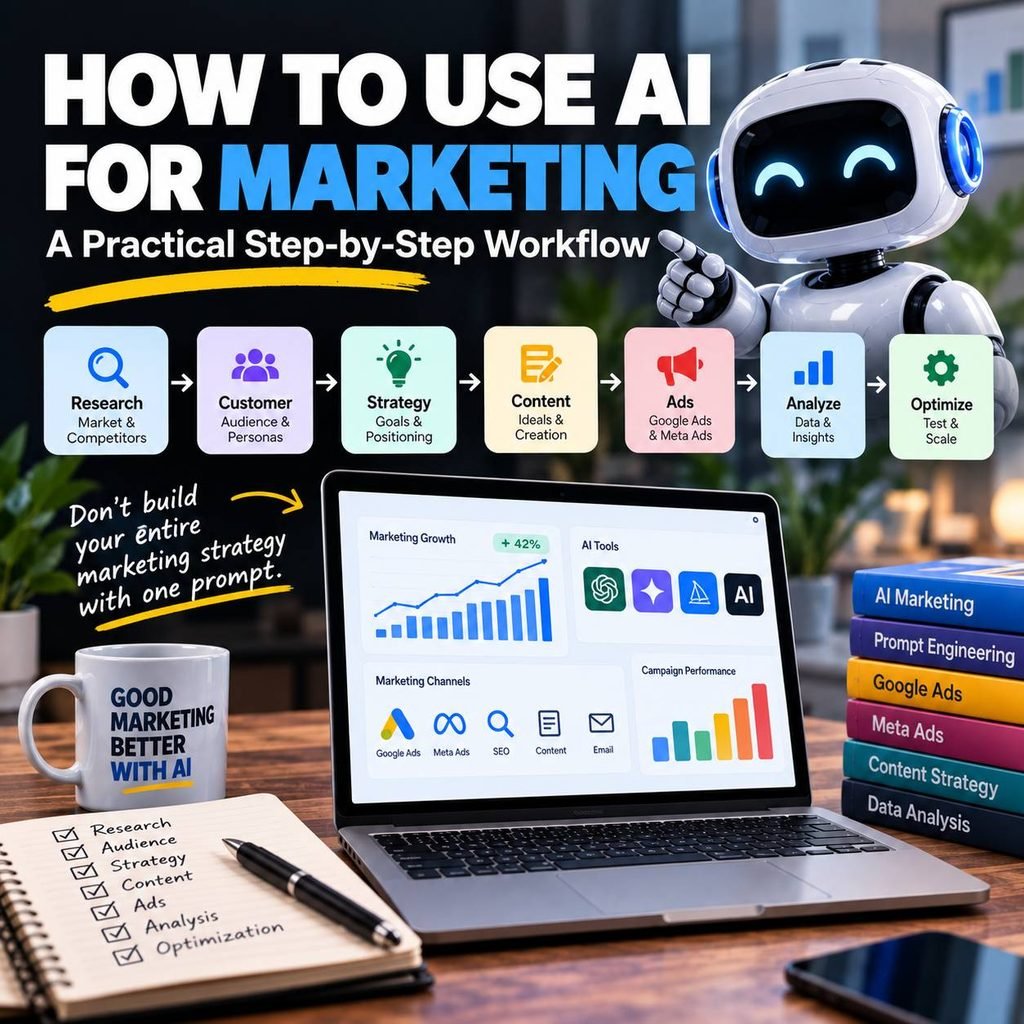
Artificial intelligence can help marketers research markets, understand customers, create content, develop advertising ideas, analyze data, and automate repetitive work.
But there is a problem.
Many people start with prompts like:
“Create a marketing strategy for my business.”
Within seconds, AI produces a complete-looking plan.
It might include customer personas, social media ideas, advertising campaigns, SEO recommendations, and even a content calendar.
It looks impressive.
But it may be built on assumptions.
A better approach is to use AI throughout a structured marketing process, rather than asking it to do everything in one prompt.
A practical AI marketing workflow looks like this:
Research → Customer → Strategy → Content → Creative → Ads → Analyze → Optimize
AI assists at every stage.
You provide the context, verify the information, and make the decisions.
In this guide, we’ll walk through that process step by step.
Table of Contents
1. Start With Market Research
Before creating content, ads, or campaigns, understand the market.
AI can help organize and accelerate market research by identifying:
- Market characteristics
- Customer problems
- Common buying motivations
- Competitor positioning
- Product categories
- Potential market segments
- Industry terminology
- Questions customers may ask
- Opportunities for further research
However, AI-generated market research should be treated as a starting point, not unquestionable fact.
Whenever possible, combine AI with real information such as:
- Search results
- Competitor websites
- Customer reviews
- Google Trends
- Analytics data
- Advertising data
- Surveys
- Sales conversations
- CRM information
Example AI prompt
Act as a marketing research assistant.
Analyze the following business:
Business: [BUSINESS]
Product or Service: [PRODUCT]
Market: [MARKET]
Location: [LOCATION]
Price Range: [PRICE]
Known Competitors: [COMPETITORS]Identify:
- Potential customer segments
- Customer problems
- Buying motivations
- Possible objections
- Competitor positioning themes
- Questions that require additional research
Clearly separate assumptions from information supported by the data provided.
Do not create a marketing strategy yet.
That final instruction matters.
We’re researching before strategizing.
2. Study Your Competitors With AI
Competitor research isn’t about copying what other businesses are doing.
It’s about understanding the environment in which your business has to compete.
AI can help compare competitors across dimensions such as:
| Area | What to Analyze |
|---|---|
| Positioning | How they describe themselves |
| Audience | Who they appear to target |
| Offer | What they sell |
| Benefits | What outcomes they emphasize |
| Pricing | How the offer is priced |
| Content | What topics they publish |
| Advertising | What messages they promote |
| CTA | What action they want users to take |
Instead of asking:
“Who are my competitors?”
a stronger workflow is to identify real competitors first and then provide their information to AI for analysis.
For example:
Compare these three competitors based only on the information provided.
Identify similarities, differences, positioning patterns, recurring customer benefits, potential gaps, and opportunities for differentiation.
Do not invent missing information.
This turns AI into a research assistant rather than a source of fabricated competitive intelligence.
3. Define the Customer
Once you understand the market, move to the customer.
AI can help organize customer information into useful segments or personas.
But avoid creating fictional personas filled with unnecessary details.
Knowing that your hypothetical customer is named Sarah, drinks coffee at 7:30 AM, and likes hiking doesn’t necessarily improve your marketing.
Focus on information that influences the buying decision.
For example:
Customer
Small business owner
Problem
Spending too much time managing marketing manually.
Goal
Generate more customers without hiring a large marketing team.
Objections
- Limited budget
- Limited time
- Doesn’t understand AI
- Concerned about complexity
Buying triggers
- Business growth
- Rising advertising costs
- Lack of internal resources
- Competitor pressure
Desired outcome
A more efficient and measurable marketing process.
That’s much more useful for strategy.
Customer research prompt
Based on the research provided, create a practical customer profile.
Focus on:
- Primary problem
- Desired outcome
- Buying motivations
- Objections
- Questions before purchasing
- Decision criteria
- Potential search behavior
- Marketing messages likely to require testing
Clearly identify any assumptions.
4. Build the Marketing Strategy
Only after researching the market, competitors, and customers should you start developing the strategy.
AI can help organize strategic options around:
Customer → Problem → Offer → Positioning → Message → Channel → Conversion
For example:
Customer: Small business owners
↓
Problem: Marketing takes too much time
↓
Offer: AI marketing platform
↓
Positioning: Practical AI learning
↓
Message: Learn workflows instead of collecting more AI tools
↓
Channels: SEO + social + search advertising
↓
Conversion: Paid membership
The important point is that AI isn’t deciding your strategy independently.
It is helping you structure the information you’ve already collected.
Strategy prompt
Using the market, competitor, and customer research provided, develop three possible marketing positioning strategies.
For each option provide:
- Target audience
- Customer problem
- Value proposition
- Core message
- Differentiator
- Recommended channels
- Potential strengths
- Potential risks
Do not choose the final strategy for me.
That last line keeps the human in control.
5. Use AI for Content Marketing
Once you have a strategy, AI becomes extremely useful for content.
But there’s a major difference between:
“Give me 100 blog ideas.”
and:
“Build content ideas around the problems my customers are actively trying to solve.”
The second approach connects content to strategy.
You can organize content around:
Educational content
Teach the audience something useful.
Problem-aware content
Help users understand a challenge.
Solution-aware content
Explain possible ways to solve that challenge.
Product-aware content
Show how your product or service solves it.
Comparison content
Help customers evaluate alternatives.
Conversion content
Address objections and buying questions.
For example, an AI marketing platform might publish:
- How to Use AI for Marketing
- How to Use AI for Google Ads
- How to Analyze Competitors With AI
- How to Create Better Marketing Prompts
- How to Use AI for Meta Ads
- How to Analyze Marketing Data With AI
Notice that these aren’t random topics.
They form a content cluster around a specific area of expertise.
6. Create Better Marketing Copy With AI
AI is excellent at producing copy variations.
But asking:
“Write a Facebook ad.”
provides almost no strategic direction.
Instead, build copy from:
Audience → Problem → Angle → Hook → Benefit → Proof → CTA
For example:
Audience
Marketers learning AI.
Problem
They’re overwhelmed by hundreds of AI tools.
Angle
You don’t need more tools.
Hook
You Don’t Need 50 AI Tools.
Benefit
Learn how to build useful AI workflows using the tools you already have.
CTA
Start learning.
Now AI can create variations around a defined advertising concept rather than generating random copy.
A useful prompt might be:
Create five ad variations based on this advertising concept.
Audience: [AUDIENCE]
Problem: [PROBLEM]
Angle: [ANGLE]
Core Benefit: [BENEFIT]
Offer: [OFFER]
CTA: [CTA]Keep the strategic angle consistent while testing different hooks.
7. Use AI to Create Marketing Images and Video
Generative AI can also support the creative process.
For images, instead of prompting:
“Create an ad for my product.”
define the visual concept.
A practical image prompt structure is:
Want to practice this workflow?
Learn AI Copywriting and Marketing with practical lessons, prompts and exercises inside IATools Pro.
Explore IATools Pro →Subject + Product + Environment + Action + Composition + Lighting + Camera + Brand Direction + Advertising Purpose + Aspect Ratio
For example:
A digital marketer working at a modern desk surrounded by multiple AI applications, looking overwhelmed, dark professional office environment, laptop in foreground, cinematic lighting, advertising composition with negative space for headline, premium technology aesthetic, square social media format.
The image supports a specific advertising angle:
You Don’t Need 50 AI Tools. You Need Better AI Workflows.
The same principle applies to AI video.
Start with the marketing concept.
Then use AI to execute it.
Strategy → Concept → Prompt → Generation → Human Review
Not:
Prompt → Random Creative
8. Use AI for Google Ads
Paid search is another area where AI can save significant time.
AI can assist with:
- Market research
- Keyword ideation
- Search intent
- Campaign structure
- Negative keywords
- Responsive Search Ads
- Search term classification
- Performance analysis
- Optimization hypotheses
But don’t ask AI to build an entire Google Ads campaign from one sentence.
A stronger process is:
Business Research → Keywords → Search Intent → Campaign Structure → RSA → Landing Page → Data → Optimization
We cover this process in more detail in our guide:
How to Use AI for Google Ads: A Practical Workflow
The same principle applies here:
AI helps organize and accelerate the work. The advertiser remains responsible for the decisions.
9. Use AI for Meta Ads
Meta Ads requires a somewhat different approach because users aren’t necessarily searching for your product when they see the advertisement.
Creative strategy becomes particularly important.
AI can help develop:
- Advertising angles
- Hooks
- Creative concepts
- Image prompts
- Video concepts
- Primary text
- Headlines
- CTA variations
- Creative testing matrices
A useful Meta Ads workflow is:
Audience → Problem → Angle → Hook → Creative Concept → Ad → Test → Analyze → Iterate
For example, instead of generating ten unrelated ads, you could test:
Angle A — Problem
Marketing takes too much time.
Angle B — Simplicity
Learn practical AI workflows.
Angle C — Cost
Learn AI marketing without buying an expensive course.
Angle D — Tool overload
You don’t need 50 AI tools.
AI can then generate controlled variations within each concept.
That produces more useful experiments.
10. Use AI for SEO
AI can accelerate many parts of SEO, including:
- Topic research
- Search intent analysis
- Content outlines
- Content clusters
- Internal linking ideas
- Metadata
- Existing content analysis
- Content refreshes
- Structured data preparation
- Keyword classification
But one of the worst applications of AI is publishing hundreds of generic articles simply because generation is inexpensive.
AI doesn’t eliminate the need for useful content.
A better SEO workflow is:
Search Intent → Research → Content Structure → Draft → Human Expertise → Review → Publish → Measure → Improve
AI accelerates the process.
It shouldn’t eliminate the process.
11. Analyze Marketing Data With AI
This is one of the most valuable AI marketing applications.
Marketing teams generate data from:
- Google Ads
- Meta Ads
- Google Analytics
- Search Console
- CRM systems
- Email platforms
- Ecommerce platforms
- Social media
AI can help organize and analyze exported datasets.
Instead of asking:
“What should I change?”
use a structured analytical framework:
Data → Observation → Hypothesis → Action
For example:
Data
Conversion rate decreased from 4.2% to 2.9%.
Observation
The current period has a lower conversion rate than the previous period.
Hypothesis
Possible causes include traffic quality, landing-page changes, device mix, campaign mix, seasonality, or tracking issues.
Action
Investigate those factors before changing the campaign.
This distinction is important.
AI can identify patterns very quickly.
But correlation isn’t automatically causation.
12. Automate Repetitive Marketing Work
Once your marketing process is structured, you can identify repetitive tasks.
Potential AI marketing automations include:
- Summarizing reports
- Categorizing leads
- Organizing customer feedback
- Generating draft content briefs
- Classifying search terms
- Summarizing campaign changes
- Preparing meeting notes
- Creating first drafts of reports
- Routing information between systems
But don’t automate a broken process.
First:
Understand the task.
Then:
Create a repeatable workflow.
Then:
Automate the appropriate parts.
A useful principle is:
Automate repetition, not judgment.
13. Build Your AI Marketing Stack
You don’t necessarily need dozens of AI applications.
A practical stack might contain tools for:
AI Assistant
Research, writing, analysis and reasoning.
Image Generation
Advertising creatives and visual concepts.
Video Generation
Short-form content and creative experimentation.
Analytics
Performance measurement.
Advertising
Google Ads and Meta Ads.
Automation
Connecting repetitive workflows.
The goal isn’t to own the largest collection of AI tools.
It’s to understand which tool belongs at which stage of the workflow.
The Complete AI Marketing Workflow
Putting everything together:
1. Research
Understand the market.
↓
2. Competitors
Understand the competitive environment.
↓
3. Customer
Identify problems, motivations and objections.
↓
4. Strategy
Define positioning, messaging and channels.
↓
5. Content
Create useful content around customer needs.
↓
6. Creative
Develop copy, images and video.
↓
7. Advertising
Launch Google Ads and Meta Ads campaigns.
↓
8. SEO
Build sustainable organic acquisition.
↓
9. Data
Measure actual performance.
↓
10. Optimization
Develop hypotheses and run controlled tests.
↓
11. Automation
Automate repetitive parts of the process.
↓
12. Iterate
Learn from the results and improve.
This is much more powerful than trying to generate an entire marketing strategy with one prompt.
AI Marketing Isn’t About Replacing the Marketer
The most useful way to think about AI marketing isn’t:
“What can AI do instead of me?”
A better question is:
“Where can AI make my existing marketing process faster or better?”
AI can research faster.
AI can organize large amounts of information.
AI can generate alternatives.
AI can help analyze data.
AI can accelerate creative production.
AI can automate repetitive tasks.
But humans still need to understand:
- The customer
- The business
- The economics
- The brand
- The competitive environment
- The quality of the data
- The consequences of a decision
The practical model is therefore:
Human Context → AI Assistance → Human Review → Execution → Real Data → AI Analysis → Human Decision
Learn AI Marketing Step by Step
You don’t need to master everything at once.
The best way to learn AI marketing is to work through the process step by step:
Research → Strategy → Create → Launch → Analyze → Optimize
Inside IATools Pro, the AI Marketing module contains 25 practical lessons covering topics including:
- AI Market & Competitor Research
- Customer Personas
- Marketing Strategy
- Content Marketing
- AI Copywriting
- AI Images
- AI Video
- Google Ads + AI
- Meta Ads + AI
- SEO with AI
- Marketing Data Analysis
- AI Marketing Automation
- Building Your AI Marketing Toolkit
- Final AI Marketing Campaign Project
IATools currently includes 42 practical AI lessons across four learning modules, plus premium resources and practical tools.
Start with 7 days of IATools Pro for $3 or get monthly access for $5.
AI assists. You make the decisions.