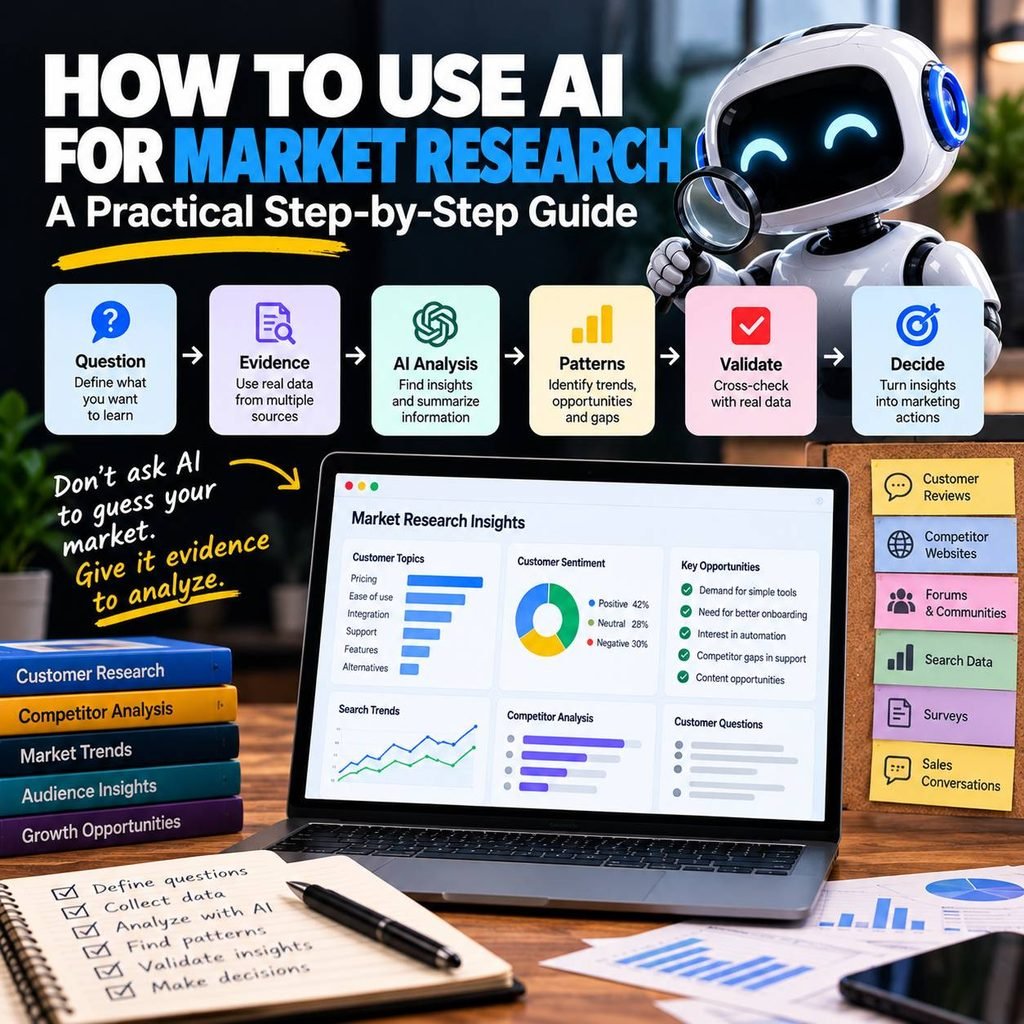
Market research is one of the most valuable applications of artificial intelligence in marketing.
AI can help you analyze customer reviews, compare competitors, organize survey responses, identify recurring problems, summarize conversations, classify search behavior, and find patterns across large amounts of information.
But there is an important distinction:
AI is much better at analyzing evidence than guessing your market.
A prompt like:
“Who is the target market for my business?”
might produce a convincing answer.
But where did that information come from?
Without real customer, competitor, search, or market data, AI may simply generate reasonable-sounding assumptions.
A better AI market research workflow is:
Question → Evidence → AI Analysis → Patterns → Validation → Decision
In this guide, we’ll build that process step by step.
Table of Contents
1. Start With a Research Question
Don’t begin by opening an AI chatbot.
Begin by deciding what you actually want to learn.
For example:
- Why do customers choose products like ours?
- What problems are customers trying to solve?
- What objections appear before purchasing?
- How are competitors positioning themselves?
- What features matter most to customers?
- What complaints appear repeatedly?
- What language do customers use to describe the problem?
- What alternatives are customers considering?
- Are there underserved customer segments?
- What questions appear before a purchase?
Compare these two requests:
Research the market for project management software.
versus:
I want to understand the main reasons small marketing agencies choose project management software, the problems they experience with existing solutions, and the factors that influence their purchasing decision.
The second question gives your research direction.
Practical framework
Before collecting data, define:
Research Question → Information Needed → Potential Sources → Analysis Method
For example:
Question: Why do customers switch project management tools?
Information needed: Complaints, desired features, switching triggers.
Sources: Reviews, forums, customer interviews, competitor comparisons.
Analysis: Categorize recurring problems and identify patterns.
Now AI has a defined job.
2. Collect Real Evidence
This is where AI market research becomes much more powerful.
Instead of asking AI what customers think, give it information showing what customers actually say.
Useful sources can include:
Customer Reviews
Reviews can reveal:
- Complaints
- Benefits
- Expectations
- Feature requests
- Reasons for switching
- Customer vocabulary
Competitor Websites
Useful for understanding:
- Positioning
- Offers
- Features
- Pricing
- Benefits
- Calls to action
- Target audiences
Forums and Communities
Discussions can reveal:
- Real questions
- Frustrations
- Alternatives
- Workarounds
- Buying considerations
Surveys
Survey responses provide direct customer feedback that can be analyzed and categorized with AI.
Search Data
Search queries can help identify:
- Customer problems
- Product demand
- Questions
- Commercial intent
- Comparison behavior
Sales Conversations
Sales teams hear customer objections and buying questions every day.
Customer Support
Support tickets can reveal recurring problems after purchase.
Analytics and Advertising Data
Actual behavioral data can help validate whether assumptions correspond with what users really do.
The goal is simple:
Give AI something meaningful to analyze.
3. Prepare Your Data Before Asking AI to Analyze It
More data isn’t automatically better.
If you combine unrelated information without explaining what it represents, the analysis may become less useful.
Organize your evidence.
For customer reviews, you might use:
| Source | Product | Rating | Review |
|---|---|---|---|
| Platform A | Product X | 2/5 | Customer comment |
| Platform B | Product X | 5/5 | Customer comment |
| Platform A | Product Y | 3/5 | Customer comment |
For survey responses:
| Question | Response |
|---|---|
| Biggest challenge? | Creating enough content |
| Current solution? | Freelancer |
| Main concern? | Cost |
| Desired result? | Faster production |
Structured input helps AI produce structured output.
4. Use AI to Analyze Customer Reviews
Customer reviews are particularly valuable because they contain natural customer language.
Imagine you collect 100 reviews from products in your market.
Instead of reading them manually and trying to remember recurring themes, AI can help classify them.
Example prompt
Analyze the following customer reviews.
Identify:
- Recurring customer problems
- Desired outcomes
- Most frequently mentioned benefits
- Common complaints
- Purchase motivations
- Reasons customers consider alternatives
- Frequently used customer language
Group similar observations into themes.
For every major conclusion, include examples from the provided evidence.
Clearly separate observations from interpretations.
Do not invent customer characteristics that aren’t present in the data.
Reviews:
[PASTE DATA]
This can transform hundreds of individual comments into useful research themes.
5. Look for Patterns, Not Individual Comments
One negative review doesn’t necessarily represent the market.
One enthusiastic customer doesn’t prove that everyone values the same benefit.
The objective is to find recurring patterns.
For example, after analyzing reviews you might discover:
Pattern 1 — Complexity
Customers repeatedly complain that existing products are difficult to configure.
Pattern 2 — Price
Smaller businesses consider several competitors too expensive.
Pattern 3 — Automation
Customers repeatedly request more automated workflows.
Pattern 4 — Support
Customer service quality appears frequently in both positive and negative reviews.
Those patterns can create research hypotheses.
For example:
Small businesses may value simplicity more than advanced customization.
Notice the wording:
may value
That’s a hypothesis requiring validation, not an established fact.
6. Analyze Competitors With AI
Competitor research is another strong use case.
Start by collecting information from actual competitors.
For each competitor, you might gather:
- Homepage messaging
- Product description
- Features
- Pricing
- Target customer
- Testimonials
- Advertising messages
- Calls to action
- Content topics
Then create a comparison.
Competitor analysis prompt
Analyze the following competitor information.
Compare each company according to:
- Target audience
- Main offer
- Positioning
- Value proposition
- Primary benefits
- Pricing approach
- Messaging themes
- Calls to action
- Potential differentiators
Then identify:
- Similarities
- Differences
- Common positioning patterns
- Potential market gaps
- Questions requiring further research
Use only the information provided.
Do not invent missing competitor information.
The purpose isn’t:
“Tell me how to beat these competitors.”
It’s first:
“Help me understand how these competitors are positioned.”
Analysis should come before strategy.
7. Analyze Survey Responses With AI
Surveys can produce valuable data, but open-ended responses are time-consuming to analyze manually.
Suppose you ask:
What’s the biggest challenge you experience when creating marketing content?
You receive 300 answers.
AI can help group responses into themes such as:
- Lack of time
- Lack of ideas
- Writing quality
- Design
- Video production
- Consistency
- Measuring results
Then you can quantify or review those categories more efficiently.
Survey analysis prompt
Analyze these open-ended survey responses.
Group responses into recurring themes.
For each theme provide:
- Theme name
- Description
- Representative responses
- Approximate frequency based on the provided dataset
- Potential implications
Keep the original meaning of responses.
Do not create categories unsupported by the data.
This is an excellent example of AI reducing repetitive analytical work.
8. Analyze Sales and Customer Conversations
Another valuable source of market intelligence is already inside many businesses:
conversations with customers.
Sales calls, emails, chat conversations, CRM notes, and customer support interactions can contain information about:
- Questions
- Objections
- Concerns
- Competitors
- Desired outcomes
- Pricing sensitivity
- Buying triggers
- Reasons for not purchasing
AI can help organize this unstructured information.
For example:
Analyze these anonymized sales notes and identify the most common objections before purchase.
Separate objections into:
- Price
- Trust
- Features
- Timing
- Competition
- Implementation
- Other
Identify recurring patterns and include supporting evidence.
Be careful with customer information.
Remove unnecessary personal or sensitive data before sending material to an AI system, and follow the privacy requirements applicable to your organization and tools.
9. Use Search Behavior as Market Research
What people search for can reveal a lot about market demand and customer intent.
Consider searches such as:
best CRM for small business
This suggests comparison or commercial investigation.
CRM pricing
This indicates interest in cost.
HubSpot alternatives
This may indicate dissatisfaction or comparison behavior.
Want to practice this workflow?
Learn AI Copywriting and Marketing with practical lessons, prompts and exercises inside IATools Pro.
Explore IATools Pro →how to manage sales leads
This expresses a problem rather than a specific product preference.
AI can help classify keyword datasets according to:
- Search intent
- Customer problem
- Funnel stage
- Product category
- Comparison behavior
- Brand/non-brand
- Potential content opportunity
But don’t ask AI to invent search volume or CPC.
Use real keyword tools and advertising platforms for actual metrics.
AI’s role is primarily to help organize and interpret the data.
10. Turn Raw Evidence Into Customer Problems
One of the most valuable outcomes of market research is identifying recurring customer problems.
Suppose your research contains statements such as:
“It takes forever to set everything up.”
“There are too many settings.”
“I just want something simple.”
“I don’t have time to learn all these features.”
AI may group these under a theme:
Complexity / Learning Curve
From there, you can formulate a research insight:
Customers frequently describe setup and learning complexity as a problem.
Then potentially a marketing hypothesis:
Simplicity could be an effective positioning angle.
Notice the progression:
Evidence → Pattern → Insight → Hypothesis
We still haven’t jumped directly to a marketing decision.
11. Separate Facts From AI Interpretation
This is one of the most important habits when using AI for market research.
Ask AI to explicitly distinguish between:
Evidence
Information directly contained in the source material.
Observation
A pattern visible across the evidence.
Interpretation
A possible explanation of that pattern.
Hypothesis
Something worth testing.
Recommendation
A possible action based on the research.
For example:
Evidence:
32 of the analyzed reviews mention difficult setup.
Observation:
Setup complexity appears repeatedly in negative reviews.
Interpretation:
The onboarding experience may be creating friction.
Hypothesis:
A simpler onboarding process could improve customer satisfaction.
Potential action:
Test simplified onboarding and measure activation.
This framework makes AI analysis much easier to evaluate.
12. Validate AI-Generated Insights
AI analysis shouldn’t be the final step.
Important findings should be validated.
You might cross-check an insight against:
- Additional customer reviews
- Analytics
- Search data
- Sales data
- Customer interviews
- Surveys
- Advertising performance
- Competitor information
Suppose AI identifies:
Customers care primarily about price.
Before repositioning your entire company around affordability, investigate whether other evidence supports that conclusion.
Perhaps price appears frequently because your dataset disproportionately contains negative reviews.
That’s why validation matters.
13. Avoid Confirmation Bias
There is another risk.
You may already believe something about your customers and unintentionally prompt AI to confirm it.
Compare:
Explain why small businesses prefer simple AI tools.
with:
Analyze whether simplicity appears to influence purchasing decisions in this dataset. Include evidence both supporting and contradicting this hypothesis.
The second prompt is much stronger.
Ask AI to look for evidence that contradicts your assumptions, not just evidence that confirms them.
Useful prompt
My current hypothesis is:
[HYPOTHESIS]
Analyze the provided evidence and identify:
- Evidence supporting the hypothesis
- Evidence contradicting it
- Evidence that is inconclusive
- Additional information needed before making a decision
This can make AI-assisted research significantly more useful.
14. Use AI to Identify Research Gaps
A good research process doesn’t just produce answers.
It reveals what you don’t know yet.
After completing an analysis, ask:
Based on the available evidence, what important questions cannot currently be answered?
Identify missing information that would materially improve our understanding of the customer or market.
Do not answer those questions using assumptions.
AI might identify gaps such as:
- Insufficient pricing information
- No evidence from former customers
- Limited information about purchasing criteria
- No geographic segmentation
- Lack of competitor pricing
- No data about why prospects don’t convert
Those gaps tell you what to research next.
15. Turn Research Into Marketing Decisions
Market research is useful only when it eventually informs action.
Research can influence:
Positioning
What makes your product different?
Messaging
Which customer problems should your marketing address?
Content
What questions deserve educational content?
SEO
What problems are customers actively searching for?
Google Ads
Which high-intent searches deserve advertising investment?
Meta Ads
Which customer problems or benefits could become advertising angles?
Product
Which recurring customer requests deserve investigation?
Sales
Which objections should your sales process address?
But the process should remain:
Evidence → Analysis → Validation → Decision
Not:
AI Answer → Decision
A Practical AI Market Research Workflow
Here’s the complete process:
Step 1 — Define the Question
What are you trying to learn?
↓
Step 2 — Identify the Evidence Needed
What information could answer that question?
↓
Step 3 — Collect Real Data
Reviews, competitors, surveys, search behavior, sales conversations, analytics, and other relevant sources.
↓
Step 4 — Organize the Information
Structure the data so AI understands what it’s analyzing.
↓
Step 5 — Analyze With AI
Identify recurring themes, similarities, differences, and potential patterns.
↓
Step 6 — Separate Evidence From Interpretation
Don’t confuse AI conclusions with facts.
↓
Step 7 — Identify Research Gaps
Determine what remains unknown.
↓
Step 8 — Validate Important Findings
Cross-check conclusions against additional sources and real data.
↓
Step 9 — Develop Hypotheses
Translate patterns into ideas worth testing.
↓
Step 10 — Make the Decision
Humans decide what actions make sense for the business.
The framework is:
Question → Evidence → AI Analysis → Patterns → Validate → Decide
Example: Using AI to Research a New Product
Imagine you’re considering launching an AI productivity product for small businesses.
Instead of asking:
“Is there demand for my AI productivity product?”
you could:
1. Define the research question
What repetitive work causes the most frustration for small businesses?
2. Collect evidence
Gather:
- Customer reviews
- Forum discussions
- Competitor reviews
- Search queries
- Survey responses
3. Analyze the evidence
Use AI to classify recurring problems.
4. Identify patterns
Perhaps you discover repeated concerns around:
- Reporting
- Content creation
- Administrative work
- Customer support
5. Validate
Compare those findings with search behavior, surveys, and existing products.
6. Decide
Choose whether one of those problems represents an opportunity worth pursuing.
That’s far more useful than asking an AI model to predict whether your idea will succeed.
AI Doesn’t Replace Market Research — It Accelerates It
AI dramatically reduces the amount of manual work required to organize and analyze information.
It can help you process:
100 reviews faster.
300 survey responses faster.
20 competitor pages faster.
Thousands of search terms faster.
But speed doesn’t eliminate the need for good research methodology.
The quality of your output still depends heavily on:
- The question you ask
- The evidence you collect
- The quality of the data
- The instructions you provide
- Your validation process
- Your business judgment
A useful principle is:
Don’t ask AI to guess your market. Give it evidence to analyze.
Learn the Complete AI Marketing Workflow
Market research is only the beginning.
Once you understand the market, the next steps are:
Research → Customer → Strategy → Content → Creative → Ads → Data → Optimization
Inside IATools Pro, you can work through the complete process with practical AI Marketing lessons covering:
- Market & Competitor Research
- Customer Personas
- Marketing Strategy
- Content Marketing
- AI Copywriting
- AI Images and Video
- Google Ads + AI
- Meta Ads + AI
- SEO
- Marketing Data Analysis
- AI Marketing Automation
- AI Marketing Toolkit
- Final Marketing Campaign Project
The complete AI Marketing module contains 25 practical lessons, and IATools currently includes 42 AI lessons across four learning modules.
Start with IATools Pro for $3 / 7 days or get monthly access for $5.
AI assists. You make the decisions.