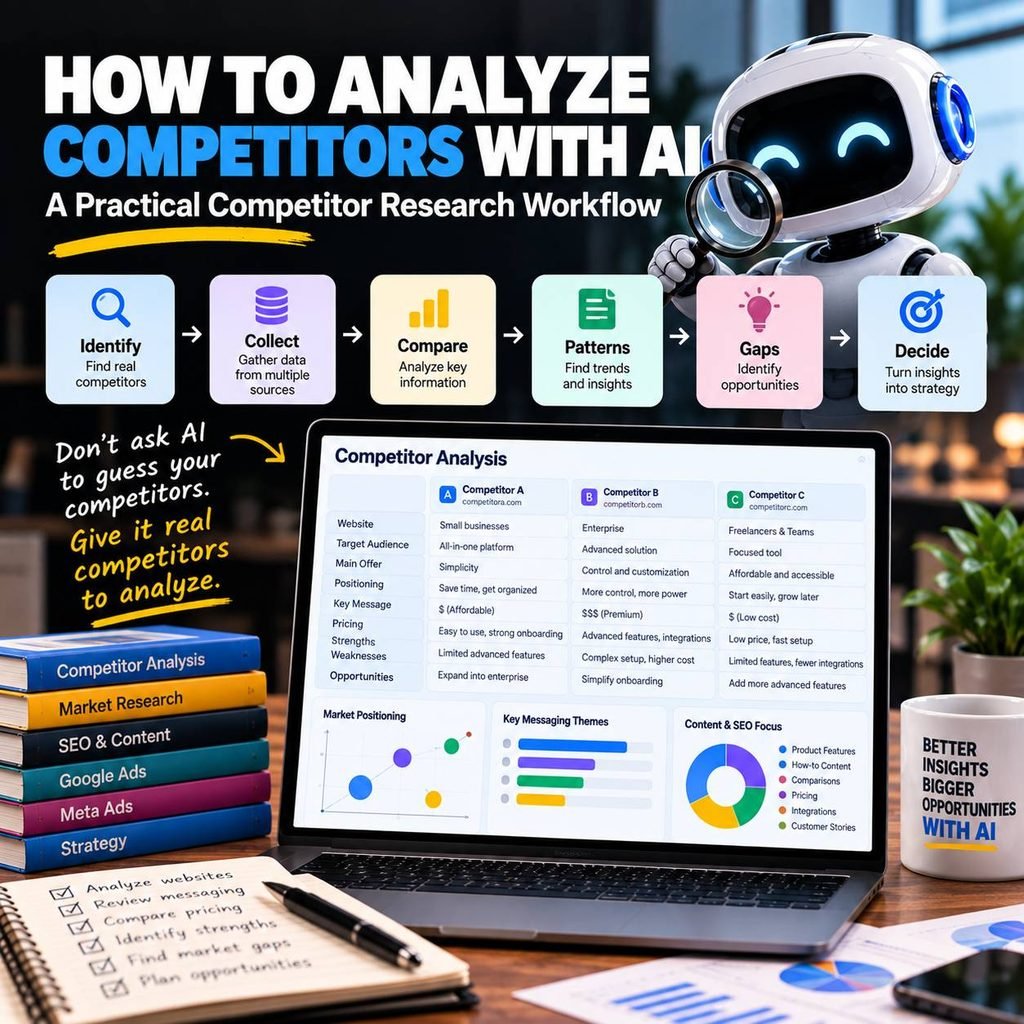
Competitor analysis is one of the most useful applications of AI in marketing.
AI can help you compare websites, organize pricing information, analyze positioning, identify messaging patterns, review customer feedback, and uncover potential gaps in a market.
But there is a common mistake:
Asking AI to guess who your competitors are and immediately build a competitive strategy.
A better approach is to identify real competitors, collect real evidence, and then use AI to analyze that information systematically.
The workflow looks like this:
Identify → Collect → Compare → Find Patterns → Find Gaps → Validate → Decide
AI accelerates the analysis.
You provide the evidence and make the strategic decisions.
Table of Contents
1. Start by Identifying the Right Competitors
Before analyzing competitors, decide who actually belongs in the comparison.
Not every company appearing in a Google search is necessarily a direct competitor.
A useful framework is to separate competitors into three groups.
Direct Competitors
Businesses selling a similar solution to a similar audience.
For example, two project management platforms targeting small marketing agencies could be direct competitors.
Indirect Competitors
Businesses solving the same underlying problem in a different way.
A project management platform might indirectly compete with spreadsheets, communication tools, or manual processes.
Aspirational Competitors
Companies that may not compete directly with you today but have positioning, content, customer experience, or marketing strategies worth studying.
AI can help organize these categories, but you should first provide actual businesses or research evidence.
2. Define What You Want to Learn
Don’t collect competitor information without a purpose.
Start with a research question.
For example:
- How do competitors position their products?
- Which customer segments are they targeting?
- What benefits do they emphasize?
- How does pricing differ?
- Which features appear repeatedly?
- What advertising messages are common?
- Which SEO topics are competitors targeting?
- What do customers complain about?
- Are competitors addressing the same customer problem?
- Where might there be a market gap?
This determines what information you need to collect.
For example:
Question: How are competitors positioning their AI marketing products?
Evidence needed: Homepage copy, product pages, pricing, headlines, benefits and CTAs.
Analysis: Compare positioning and identify recurring themes.
Now AI has a specific analytical task.
3. Collect Real Competitor Data
This is the most important part of the workflow.
Instead of asking AI:
“Tell me everything about Competitor X.”
collect information directly from relevant sources.
Useful competitor data can include:
Website
Analyze:
- Homepage
- Product pages
- Service pages
- About page
- Landing pages
Pricing
Collect:
- Entry price
- Monthly plans
- Annual plans
- Free trials
- Freemium offers
- Feature differences
Messaging
Capture:
- Headlines
- Value propositions
- Benefits
- Claims
- Calls to action
Products and Features
Identify:
- Main products
- Features
- Integrations
- Use cases
- Customer segments
Content
Review:
- Blog topics
- Guides
- Tutorials
- Case studies
- Comparison pages
- Educational resources
Search Presence
Look at:
- Organic results
- Paid search ads
- Brand searches
- Important keyword categories
Social Media
Review:
- Content themes
- Formats
- Engagement
- Offers
- Advertising concepts
Customer Reviews
Reviews can reveal what the company’s own marketing doesn’t.
Look for:
- Positive experiences
- Complaints
- Feature requests
- Switching reasons
- Pricing concerns
- Customer support experiences
The objective is to create a dataset based on evidence rather than assumptions.
4. Organize Competitor Information
Before giving information to AI, structure it.
For example:
| Competitor | Audience | Offer | Positioning | Key Message | Pricing |
|---|---|---|---|---|---|
| Competitor A | Small businesses | SaaS platform | Simplicity | Save time | $ |
| Competitor B | Enterprise | Advanced platform | Control | More flexibility | $$$ |
| Competitor C | Freelancers | Focused tool | Affordability | Start easily | $ |
You could expand the table with:
- Features
- CTA
- Free trial
- Content strategy
- SEO topics
- Advertising
- Customer complaints
- Strengths
- Potential weaknesses
Structured information makes comparison easier for both humans and AI.
5. Analyze the Data With AI
Once you have the evidence, AI becomes extremely useful.
Instead of manually comparing dozens of pages, you can ask AI to organize the information.
Competitor Analysis Prompt
Analyze the following competitor information using only the evidence provided.
For each competitor identify:
- Target audience
- Products or services
- Value proposition
- Positioning
- Main benefits
- Pricing approach
- Marketing messages
- Calls to action
- Strengths
- Potential weaknesses
Then compare the competitors and identify:
- Recurring positioning patterns
- Important differences
- Potential market gaps
- Opportunities requiring further validation
Clearly separate facts, observations and hypotheses.
Do not invent missing information.
Competitor data:
[PASTE DATA]
This final instruction is critical:
Do not invent missing information.
Missing information should remain missing until you research it.
6. Compare Competitor Positioning
Positioning tells you how a company wants customers to perceive its product.
Imagine three competitors:
Competitor A
The easiest marketing platform for small businesses.
Positioning: simplicity
Competitor B
Advanced marketing automation for growing teams.
Positioning: power and automation
Competitor C
Everything you need to launch marketing campaigns for $10/month.
Positioning: affordability and completeness
AI can compare these messages and identify the strategic territory each competitor appears to occupy.
You might discover:
Competitor A → Simple
Competitor B → Advanced
Competitor C → Affordable
That doesn’t automatically tell you how your business should position itself.
But it gives you a clearer picture of the competitive landscape.
7. Analyze Competitor Messaging
Next, look deeper than the positioning statement.
Collect:
- Headlines
- Subheadlines
- Product descriptions
- Benefit statements
- CTA language
- Advertising copy
Then ask AI to classify recurring messaging themes.
For example:
Speed
“Launch campaigns faster.”
Simplicity
“No technical knowledge required.”
Productivity
“Save hours every week.”
Growth
“Generate more customers.”
Cost
“Reduce your marketing costs.”
Automation
“Put repetitive work on autopilot.”
If nearly every competitor emphasizes speed, that tells you something about the category.
It could mean speed is an important customer priority.
Or it could mean the category has become saturated with the same message.
Both possibilities deserve investigation.
8. Compare Pricing and Offers
Pricing analysis is another area where structured AI analysis can help.
Create a table containing real pricing data:
| Competitor | Entry Plan | Monthly | Annual | Trial | Free Plan |
|---|---|---|---|---|---|
| A | $9 | $19 | $190 | Yes | No |
| B | $0 | $29 | $290 | No | Yes |
| C | $15 | $39 | $390 | Yes | No |
Then analyze:
- Entry barriers
- Free trials
- Freemium strategies
- Monthly vs. annual discounts
- Feature restrictions
- Upgrade paths
- Pricing segmentation
But don’t conclude:
“We should be cheaper.”
Price is only one component of positioning.
A premium competitor may have stronger brand recognition, better features, better support, or a different customer segment.
AI can organize the comparison.
Business economics should determine your pricing decisions.
9. Analyze Competitor SEO and Content
Competitor analysis can also help your content strategy.
Review what competitors publish.
For example:
Competitor A
- Beginner guides
- Tutorials
- Product education
Competitor B
- Enterprise reports
- Industry research
- Case studies
Competitor C
- Comparison pages
- Alternatives
- Templates
AI can help categorize content into themes and identify patterns.
Useful questions include:
- Which topics appear repeatedly?
- Which customer problems are being addressed?
- Which funnel stages receive the most content?
- Are competitors publishing comparison content?
- Are there important topics competitors barely cover?
- What content formats are common?
This can help you build a content map.
But don’t create content simply because a competitor has it.
The topic still needs to make sense for your audience and strategy.
10. Analyze Competitor Advertising
Paid advertising provides another perspective.
Competitor ads can reveal:
Want to practice this workflow?
Learn AI Copywriting and Marketing with practical lessons, prompts and exercises inside IATools Pro.
Explore IATools Pro →- Current offers
- Promotional messages
- Product priorities
- Customer problems
- Benefits
- Landing pages
- Advertising angles
For example, imagine seeing these three advertising messages:
Save 10 Hours Every Week
Automate Your Marketing
Start Free — No Credit Card Required
AI can classify them as:
Productivity angle
Automation angle
Low-risk acquisition angle
You can then compare which advertising angles are common across competitors.
This doesn’t mean you should copy them.
Instead ask:
What does this tell us about how companies in this category are trying to acquire customers?
11. Analyze Customer Reviews of Competitors
This is one of the most valuable parts of competitive research.
A competitor’s website tells you how the company describes itself.
Reviews tell you how customers experience the product.
Collect a meaningful sample of reviews and analyze:
Positive themes
What do customers consistently like?
Negative themes
What complaints appear repeatedly?
Missing features
What do customers wish existed?
Switching triggers
Why did customers leave another solution?
Price sensitivity
Do customers think the product is expensive or valuable?
Support
Is customer service frequently mentioned?
Complexity
Do customers struggle with setup or usability?
Example prompt
Analyze these competitor customer reviews.
Identify recurring:
- Positive experiences
- Complaints
- Desired features
- Customer problems
- Reasons for switching
- Pricing concerns
- Support issues
Group similar comments into themes.
Distinguish frequent patterns from isolated comments.
Include supporting evidence for important observations.
Do not infer customer characteristics that aren’t present in the reviews.
This can reveal opportunities that competitor marketing pages won’t.
12. Find Patterns Across Competitors
Now move from individual competitors to the entire category.
Suppose your research finds:
Competitor A: simplicity
Competitor B: automation
Competitor C: simplicity
Competitor D: productivity
Competitor E: simplicity
A clear pattern appears:
Simplicity is heavily used as a positioning theme.
That leads to useful questions:
- Is simplicity genuinely important to customers?
- Is the market saturated with this message?
- Could another benefit differentiate us?
- Do customer reviews support the simplicity claim?
- Does “simple” mean the same thing across competitors?
AI is particularly useful at identifying these recurring patterns across larger datasets.
13. Look for Potential Market Gaps
A market gap is not simply something competitors aren’t doing.
There must also be evidence that customers want or need it.
Suppose:
Competitors emphasize advanced AI features.
Customer reviews repeatedly complain that the products are difficult to use.
That combination might suggest:
There may be an opportunity for a simpler AI product.
But that’s still a hypothesis.
The correct process is:
Competitor Evidence + Customer Evidence → Potential Gap → Validation
Not:
Competitor Doesn’t Have Feature → Business Opportunity
That distinction can prevent expensive mistakes.
14. Separate Facts, Observations and Hypotheses
As with all AI-assisted research, maintain clear boundaries.
Fact
Competitor A charges $29/month.
Observation
Competitor A is the most expensive company in the comparison.
Interpretation
Its pricing may reflect premium positioning.
Hypothesis
Customers may associate the higher price with greater functionality.
Decision
Determine whether premium positioning makes sense for your own business.
AI can help generate the middle layers.
But don’t allow interpretation to quietly become fact.
15. Ask AI to Challenge Your Conclusions
AI shouldn’t only confirm what you already believe.
Suppose your hypothesis is:
Competitors are too expensive, so a cheaper product will win.
Ask AI:
Evaluate this hypothesis using the competitor and customer evidence provided.
Identify:
- Evidence supporting it
- Evidence contradicting it
- Evidence that is inconclusive
- Alternative explanations
- Additional data required before making a pricing decision
This is much stronger than asking:
Why should we offer a cheaper product?
The first question encourages analysis.
The second encourages confirmation.
16. Turn Competitor Analysis Into Strategy
Competitive research can influence several areas of marketing.
Positioning
Where does your product fit in the competitive landscape?
Messaging
Which claims are overused?
Which customer problems deserve more attention?
Product
Which complaints or unmet needs appear repeatedly?
Pricing
How are competing offers structured?
Content
Which topics dominate the category?
Which useful topics are underserved?
SEO
Which search themes are competitors pursuing?
Google Ads
Which commercial searches and messages appear important?
Meta Ads
Which advertising angles are being used?
Sales
Which competitor comparisons or objections should your team understand?
The research becomes useful when it informs better decisions.
A Practical AI Competitor Analysis Workflow
Here’s the complete process.
Step 1 — Identify
Find real direct, indirect, and relevant aspirational competitors.
↓
Step 2 — Define the Question
Determine what you actually want to learn.
↓
Step 3 — Collect
Gather evidence from websites, pricing, content, ads, reviews, and other relevant sources.
↓
Step 4 — Structure
Organize the information into comparable categories.
↓
Step 5 — Analyze
Use AI to summarize and compare the evidence.
↓
Step 6 — Find Patterns
Identify recurring positioning, messaging, pricing, content, and customer themes.
↓
Step 7 — Find Potential Gaps
Look for differences between what competitors provide and what customers appear to need.
↓
Step 8 — Validate
Use additional customer and market evidence to test those ideas.
↓
Step 9 — Decide
Turn validated insights into business and marketing decisions.
The framework is:
Identify → Collect → Compare → Patterns → Gaps → Validate → Decide
Competitor Analysis Example
Imagine you’re researching AI marketing education platforms.
You analyze five competitors.
Several patterns emerge:
- Most emphasize the number of AI tools available.
- Several promote large prompt libraries.
- Most teach individual tools.
- Pricing varies significantly.
- Customer discussions suggest people feel overwhelmed by the number of new AI applications.
You might formulate this hypothesis:
Instead of offering more tools, there may be an opportunity to teach people better AI workflows.
That’s useful.
But you shouldn’t immediately rebuild your entire positioning around it.
Next, validate the hypothesis using:
- Search behavior
- Customer interviews
- Surveys
- Community discussions
- Landing-page experiments
- Advertising tests
Now competitor research has produced a testable strategic idea.
AI Should Analyze Competitors, Not Copy Them
One final warning:
Competitor analysis shouldn’t turn into competitor imitation.
If every competitor says:
“Save time with AI.”
and you decide to say exactly the same thing, your research hasn’t created differentiation.
The purpose is to understand:
What competitors do.
What customers want.
Where patterns exist.
Where opportunities may exist.
Then decide where your business belongs.
A useful principle is:
Don’t ask AI to guess your competitors. Give it real competitors to analyze.
Learn the Complete AI Marketing Workflow
Competitor analysis is one part of a larger marketing process.
The complete workflow continues:
Market Research → Competitor Analysis → Customer → Strategy → Content → Creative → Ads → Data → Optimization
Inside IATools Pro, the AI Marketing module includes practical lessons covering:
- AI Market & Competitor Research
- Customer Personas
- Marketing Strategy
- Content Marketing
- AI Copywriting
- AI Images & Video
- Google Ads + AI
- Meta Ads + AI
- SEO with AI
- Marketing Data Analysis
- AI Marketing Automation
- AI Marketing Toolkit
- Final AI Marketing Campaign
The module contains 25 practical AI Marketing lessons, within 42 practical AI lessons across IATools.
Start with IATools Pro for $3 / 7 days or get monthly access for $5.
AI assists. You make the decisions.