AI can generate marketing copy in seconds.
Headlines. Ads. Emails. Landing pages. Social posts. Product descriptions.
But speed creates a new problem:
Generating more copy doesn’t automatically generate better copy.
A prompt like:
“Write 10 Facebook ads for my product.”
will probably produce something usable.
But it may also produce generic benefits, predictable hooks, exaggerated claims, repetitive language, and copy that sounds similar to what thousands of other businesses are generating with AI.
The solution isn’t necessarily a better AI model.
It’s a better process.
A practical AI copywriting workflow looks like this:
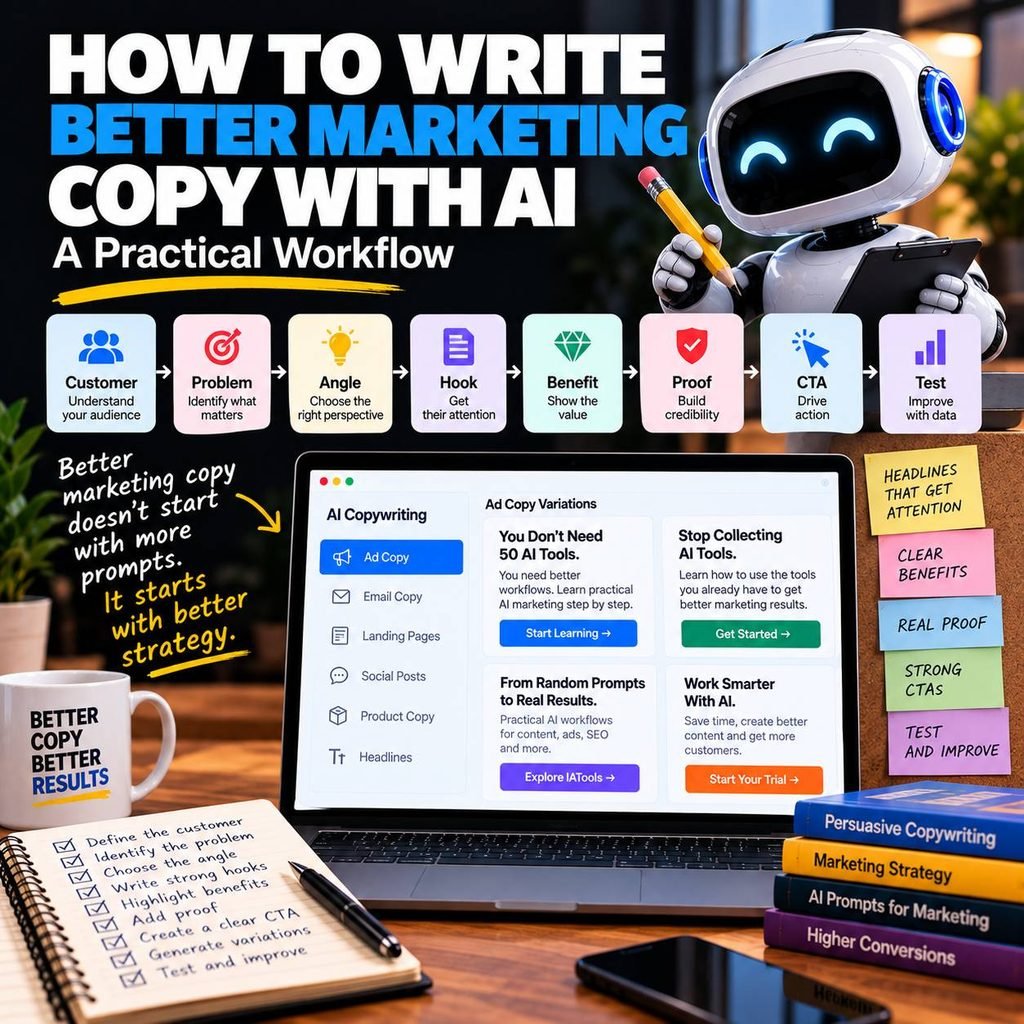
Customer → Problem → Angle → Hook → Benefit → Proof → CTA → Variations → Test
AI helps you explore and execute each stage.
You provide the strategy, evidence, context, and final judgment.
Table of Contents
1. Don’t Start by Asking AI to Write Copy
This is one of the most common mistakes in AI marketing.
You open ChatGPT or another AI assistant and write:
Write an ad for my business.
The AI doesn’t know enough.
It may not understand:
- Who you’re targeting
- What the customer actually wants
- Why they would buy
- What makes your offer different
- Which objections matter
- What evidence supports your claims
- Where the copy will appear
- What action you want the reader to take
So AI fills the gaps.
And that’s where generic marketing copy comes from.
Before writing anything, provide context.
2. Start With the Customer
Good copy isn’t primarily about the product.
It’s about connecting the product to something the customer cares about.
Before generating copy, define:
Who is the customer?
What problem are they experiencing?
What are they trying to achieve?
What frustrates them?
What have they already tried?
What objections could prevent them from buying?
What language do they use to describe the problem?
Ideally, this information should come from actual research:
- Customer reviews
- Surveys
- Sales conversations
- Support tickets
- Search queries
- Community discussions
- Analytics
- Competitor reviews
Then AI can help organize that evidence.
Example prompt
Analyze the following customer research.
Identify:
- Primary problems
- Desired outcomes
- Common objections
- Buying motivations
- Frequently used language
- Questions customers ask before purchasing
Use only the information provided.
Clearly distinguish evidence from interpretation.
Do not write marketing copy yet.
Customer research:
[PASTE DATA]
Again, notice:
Don’t write the copy yet.
First understand the customer.
3. Define the Marketing Objective
Copy needs a job.
An advertisement designed to generate awareness shouldn’t necessarily look like an email designed to recover an abandoned cart.
Define what you want the copy to accomplish.
Examples:
- Generate a click
- Capture a lead
- Sell a product
- Start a free trial
- Encourage a booking
- Generate a phone call
- Get someone to read an article
- Introduce a new product
- Retarget an existing visitor
Then define the channel.
For example:
Objective: Generate trial signups
Channel: Meta Ads
Audience: Marketers interested in AI
Offer: 7 days for $3
CTA: Start Learning
That gives AI significantly more direction than:
Write an ad for IATools.
4. Choose an Advertising Angle
This is where AI copywriting becomes much more interesting.
Don’t immediately generate 20 variations.
First decide what argument you’re making.
An angle is the perspective used to present the offer.
For example, imagine you’re promoting an AI learning platform.
Problem Angle
Too many AI tools, not enough practical knowledge.
Productivity Angle
Learn workflows that help you work faster.
Learning Angle
Stop watching random tutorials and follow a structured process.
Cost Angle
Learn practical AI skills without buying an expensive course.
Simplicity Angle
You don’t need 50 AI tools.
Transformation Angle
Move from random prompts to structured AI workflows.
These are strategically different advertisements.
AI can help generate potential angles.
But the marketer should decide which ones deserve testing.
5. Build the Hook
The hook earns attention.
It gives someone a reason to continue reading.
Hooks can use different structures.
Challenge an assumption
You Don’t Need 50 AI Tools.
Identify a mistake
Stop Asking AI to Write 10 Ads.
Introduce a problem
Your AI Copy Sounds Generic for a Reason.
Create curiosity
The AI Tool Probably Isn’t the Problem.
Promise a useful outcome
Write Better Marketing Copy With This AI Workflow.
Contrast two approaches
More Prompts ≠ Better Marketing.
The hook doesn’t need to explain everything.
Its job is to create enough interest for the reader to continue.
6. Connect the Hook to a Real Problem
A strong hook without substance becomes clickbait.
After earning attention, connect the message to something meaningful.
For example:
You Don’t Need 50 AI Tools.
Most marketers keep switching between new AI platforms hoping the next tool will produce better results.
But the real improvement often comes from better context, better instructions, and better workflows.
Now the hook leads naturally into the message.
AI can generate dozens of hooks.
But you should evaluate whether the body of the copy actually supports them.
7. Turn Features Into Benefits
AI often defaults to listing features.
For example:
42 AI lessons
Premium prompts
AI tools
Marketing workbook
Those are useful facts.
But customers also want to understand:
Why should I care?
Translate features into outcomes.
Feature
42 practical AI lessons.
Benefit
Follow a structured learning path instead of jumping between random tutorials.
Feature
Marketing prompts.
Benefit
Start with structured frameworks instead of writing every prompt from scratch.
Feature
AI marketing lessons.
Benefit
Learn how to apply AI to research, content, Google Ads, Meta Ads, SEO, analysis, and automation.
A useful AI prompt is:
Convert these product features into potential customer benefits.
Do not exaggerate the outcome.
For each feature provide:
- Feature
- Functional benefit
- Practical customer outcome
- Claims that would require additional evidence
This helps prevent AI from turning a simple feature into an unsupported promise.
8. Give AI Proof
Marketing copy becomes stronger when claims are supported.
Proof can include:
- Product specifications
- Demonstrations
- Customer testimonials
- Reviews
- Case studies
- Performance data
- Certifications
- Research
- Guarantees
- Real product features
But AI should never invent proof.
If you don’t have a testimonial, don’t ask AI to create one that looks real.
If you don’t have performance data, don’t publish fabricated percentages.
If you can’t substantiate:
“Increase sales by 300%”
don’t use it simply because AI generated it.
A useful instruction is:
Use only the proof provided. Do not invent testimonials, statistics, customers, awards, certifications, or performance claims.
This should be standard practice when using AI for advertising.
9. Create the Call to Action
Your CTA should match the next step.
Examples include:
Learn More
Start Learning
Get Started
Book a Consultation
Start Your Trial
Explore the Course
Download the Guide
Shop Now
Don’t automatically use the strongest possible CTA.
A user discovering your brand for the first time may respond differently from someone who has already visited your pricing page three times.
The CTA should match:
Audience Awareness + Offer + Channel + Funnel Stage
10. Now Ask AI to Write the Copy
Only now are we ready for generation.
You’ve already defined:
- Customer
- Problem
- Objective
- Channel
- Angle
- Hook direction
- Benefits
- Proof
- CTA
That’s a dramatically better starting point.
Practical AI Copywriting Prompt
Act as a marketing copywriting assistant.
Create marketing copy using the following information.
Audience: [AUDIENCE]
Customer Problem: [PROBLEM]
Desired Outcome: [OUTCOME]
Product: [PRODUCT]
Offer: [OFFER]
Marketing Angle: [ANGLE]
Primary Benefit: [BENEFIT]
Proof: [PROOF]
Channel: [CHANNEL]
Objective: [OBJECTIVE]
CTA: [CTA]Create:
- 5 hook variations
- 3 body copy variations
- 3 CTA variations
Keep the core marketing angle consistent.
Avoid clichés, exaggerated claims and unnecessary hype.
Do not invent statistics, testimonials, guarantees or product features.
That’s considerably stronger than:
Write me 10 ads.
11. Generate Controlled Variations
One of AI’s biggest advantages is variation.
But random variation isn’t necessarily useful.
Imagine AI generates:
Ad A: Focuses on price
Ad B: Focuses on productivity
Ad C: Focuses on beginners
Ad D: Focuses on automation
Ad E: Focuses on marketing
If performance changes, what did you actually learn?
Too many variables changed.
Instead, create controlled variations.
For example:
Same angle: Tool Overload
Hook A
You Don’t Need 50 AI Tools.
Hook B
Want to practice this workflow?
Learn AI Copywriting and Marketing with practical lessons, prompts and exercises inside IATools Pro.
Explore IATools Pro →Stop Collecting AI Tools.
Hook C
Another AI Tool Won’t Fix Your Workflow.
Now you’re testing different hooks around the same strategic concept.
That’s a more useful experiment.
12. Use a Copy Testing Matrix
A simple testing framework can look like this:
| Angle | Hook | Benefit | CTA |
|---|---|---|---|
| Tool overload | You Don’t Need 50 AI Tools | Better workflows | Start Learning |
| Tool overload | Stop Collecting AI Tools | Better workflows | Explore IATools |
| Productivity | Work Smarter With AI | Save time | Start Learning |
| Learning | Stop Watching Random Tutorials | Structured learning | Explore Lessons |
This turns AI from a random copy generator into a creative experimentation tool.
You can test:
Angle vs. Angle
or:
Hook vs. Hook
or:
CTA vs. CTA
without changing everything simultaneously.
13. Adapt Copy to the Channel
The same copy shouldn’t automatically be used everywhere.
Different channels create different contexts.
Google Ads
The user is actively searching.
Focus on:
- Search intent
- Relevance
- Offer
- Differentiation
- CTA
Meta Ads
You’re interrupting the feed.
The hook and creative concept become especially important.
You may already have a relationship with the reader.
Context and segmentation matter.
Landing Pages
You have more space to explain:
- Problem
- Solution
- Benefits
- Proof
- Objections
- Offer
- CTA
Social Media
The content may need to deliver value before asking for anything.
AI can adapt one core concept to multiple channels while preserving the strategy.
14. Use AI to Improve Existing Copy
AI doesn’t only need to generate new copy.
It can analyze something you’ve already written.
For example:
Review the following landing-page copy.
Do not rewrite it yet.
Analyze:
- Clarity
- Audience relevance
- Value proposition
- Benefits
- Specificity
- Proof
- Objections
- CTA
- Unnecessary jargon
- Unsupported claims
Identify the three biggest weaknesses and explain why they may reduce effectiveness.
This is often more valuable than immediately asking AI:
Make this better.
Analysis first.
Rewrite second.
15. Ask AI to Remove “AI-Sounding” Copy
Generic AI marketing copy often contains patterns like:
Revolutionize your business.
Unlock the power of AI.
Take your marketing to the next level.
In today’s fast-paced digital landscape…
These phrases aren’t automatically wrong.
They’re simply overused and often lack specificity.
Ask AI to identify them.
Prompt
Review this marketing copy for generic or predictable AI-generated language.
Highlight:
- Clichés
- Vague benefits
- Excessive adjectives
- Unnecessary hype
- Repetitive sentence structures
- Claims lacking evidence
Suggest more specific alternatives while preserving the original meaning.
This is an excellent editing step.
16. Make the Copy More Specific
Compare:
Improve your marketing with AI.
with:
Use AI to research competitors, develop ad concepts, analyze campaign data, and organize repetitive marketing tasks.
The second is more specific.
Compare:
Learn everything about AI marketing.
with:
Learn practical AI workflows for content, Google Ads, Meta Ads, SEO, data analysis, and automation.
Again, specificity makes the message easier to understand.
Whenever AI generates vague copy, ask:
What exactly does this mean?
Then rewrite it with concrete information.
17. Don’t Let AI Overpromise
AI often tries to make marketing copy more persuasive by strengthening claims.
For example:
Original:
AI can help analyze campaign data.
AI rewrite:
Transform your campaign performance and maximize ROI with powerful AI insights.
That sounds more exciting.
But it also makes a much bigger promise.
Your editing process should ask:
Can we prove this?
Is this what the product actually does?
Could a reasonable customer misunderstand this claim?
Better marketing copy isn’t necessarily louder.
Often, it’s simply clearer and more credible.
18. Use AI to Analyze Performance
The workflow shouldn’t stop after publishing the copy.
Once campaigns run, you have real performance data.
For advertising, that might include:
- Impressions
- CTR
- CPC
- Conversion rate
- CPA
- ROAS
- Engagement
- Video retention
Now you can compare creative concepts.
For example:
| Angle | CTR | Conversion Rate | CPA |
|---|---|---|---|
| Tool Overload | 2.8% | 4.1% | $18 |
| Productivity | 2.1% | 5.2% | $16 |
| Price | 3.4% | 2.0% | $29 |
The highest CTR doesn’t necessarily produce the best business result.
AI can help analyze these differences.
Use:
Data → Observation → Hypothesis → Next Test
19. Let Real Results Improve Future AI Copy
This is where AI copywriting becomes much more powerful.
Instead of continuously generating new ideas from nothing, give AI your historical results.
For example:
Here are 20 ads and their performance data.
Analyze whether recurring patterns exist among higher-performing ads.
Compare:
- Angles
- Hooks
- Benefits
- Length
- CTA
- Message structure
Clearly distinguish observations from hypotheses.
Do not assume correlation proves causation.
Recommend three controlled experiments for the next campaign.
Now your AI workflow begins learning from your marketing evidence, not just generic copywriting principles.
The Complete AI Marketing Copy Workflow
Putting everything together:
1. Customer
Understand who you’re talking to.
↓
2. Problem
Identify what matters to them.
↓
3. Objective
Decide what the copy needs to accomplish.
↓
4. Angle
Choose the argument.
↓
5. Hook
Earn attention.
↓
6. Benefit
Explain why the offer matters.
↓
7. Proof
Support your claims.
↓
8. CTA
Define the next action.
↓
9. Generate
Use AI to create structured variations.
↓
10. Review
Remove generic language, exaggeration and unsupported claims.
↓
11. Test
Run controlled experiments.
↓
12. Analyze
Use actual performance data.
↓
13. Iterate
Apply what you learn to the next creative cycle.
The framework is:
Customer → Problem → Angle → Hook → Benefit → Proof → CTA → Variations → Test → Learn
Example: From Generic AI Prompt to Better Marketing Copy
Let’s compare the two approaches.
Generic prompt
Write an ad for an AI learning platform.
Possible result:
Unlock the power of AI and transform your future! Learn cutting-edge AI skills and take your knowledge to the next level.
It’s readable.
But it could describe almost any AI course.
Now provide strategy.
Context
Audience: Marketers interested in using AI
Problem: Overwhelmed by new tools and random tutorials
Angle: Better workflows > more tools
Benefit: Structured practical learning
Offer: IATools Pro
CTA: Start Learning
Now we can develop:
You Don’t Need 50 AI Tools.
You need to know which tool to use, how to give it better instructions, and where it fits into your workflow.
Learn practical AI workflows for marketing, content, images, video, analysis and automation.
Start learning with IATools Pro.
The AI model didn’t necessarily change.
The input strategy did.
Better AI Copy Starts Before the Prompt
AI is extremely good at generating language.
That’s exactly why marketers need to become better at deciding what language should be generated.
Don’t start with:
Write an ad.
Start with:
Who are we talking to?
What do they care about?
What evidence do we have?
Which angle are we testing?
What do we want them to do?
Then use AI.
The principle is simple:
Better marketing copy doesn’t start with more prompts. It starts with better strategy.
Learn AI Copywriting as Part of the Complete Marketing Workflow
Copywriting doesn’t exist in isolation.
It connects directly to:
Market Research → Competitor Analysis → Customer → Strategy → Content → Copy → Creative → Ads → Data → Optimization
Inside IATools Pro, the AI Marketing module includes practical lessons covering:
- Market & Competitor Research
- Customer Personas
- Marketing Strategy
- Content Marketing
- AI Copywriting & Better Marketing Prompts
- AI Images
- AI Video
- Google Ads + AI
- Meta Ads + AI
- SEO with AI
- Marketing Data Analysis
- AI Marketing Automation
The AI Marketing module includes 25 practical lessons, within the 42 practical AI lessons available across IATools.
Start with IATools Pro for $3 / 7 days or get monthly access for $5.
AI assists. You make the decisions.