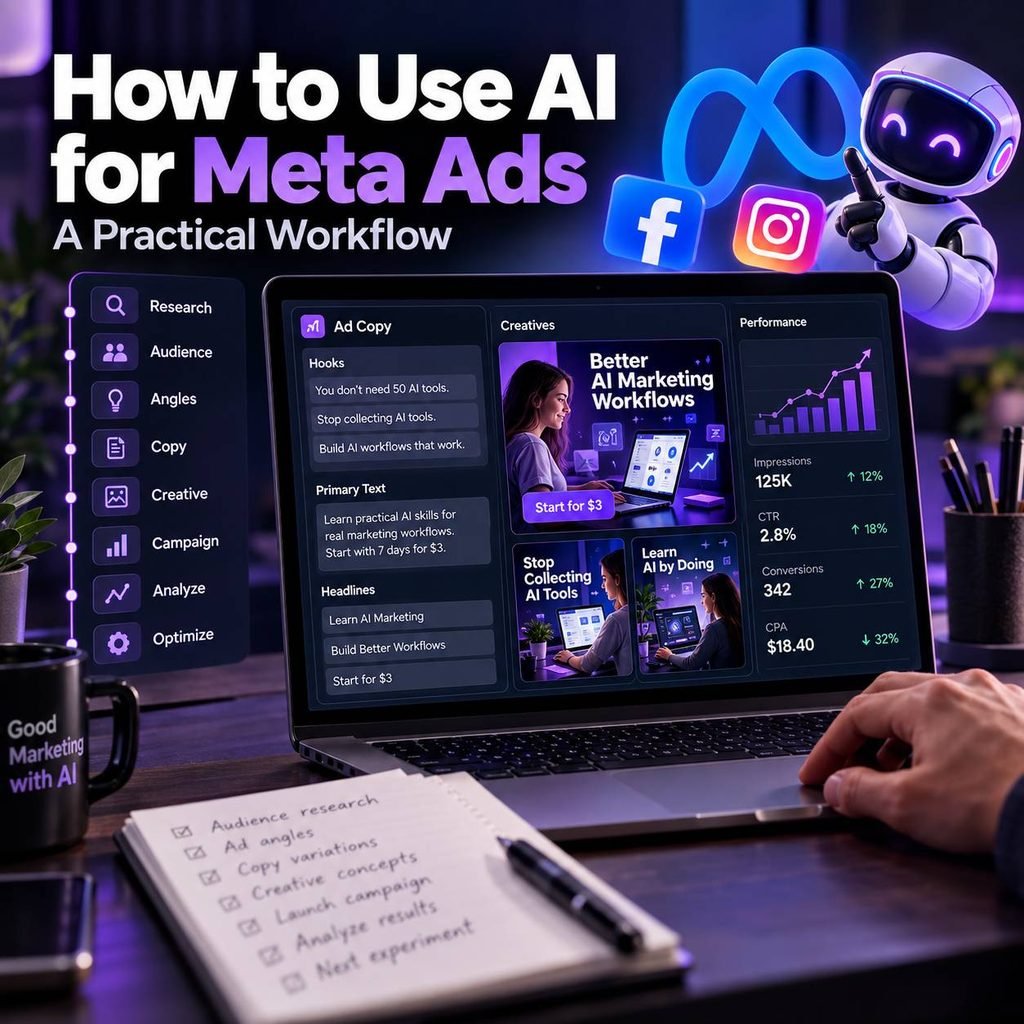
AI can help you research audiences, discover advertising angles, write ad copy, develop creative concepts, analyze campaign data, and generate ideas for your next Meta Ads experiment.
But there’s an important distinction:
AI should help you make better advertising decisions—not make those decisions for you.
A weak workflow looks like this:
“Create 10 Facebook ads for my business.”
A stronger workflow is:
Research → Audience → Angle → Copy → Creative → Campaign → Analyze → Optimize
This guide explains how to use AI across the complete Meta Ads workflow without relying on generic prompts, invented customer insights, or automated recommendations without context.
Table of Contents
What Can AI Actually Do for Meta Ads?
AI is especially useful when you need to process information, generate variations, identify patterns, or structure an advertising experiment.
For Meta Ads, you can use AI to help with:
- Market research
- Audience research
- Customer pain points
- Competitor analysis
- Advertising angles
- Ad copy
- Headlines
- Creative concepts
- Image prompts
- Video concepts
- Campaign planning
- Performance analysis
- Testing ideas
- Optimization hypotheses
The mistake is treating all of these as one task.
Instead of asking AI to:
“Build my Meta Ads campaign.”
break the campaign into smaller decisions.
That gives you more control and usually produces better outputs.
1. Start With the Business, Not the Ad
Before generating anything, AI needs context.
At minimum, define:
Business: What do you sell?
Product or service: What exactly are you advertising?
Audience: Who might buy it?
Location: Where can customers purchase or access it?
Price: How much does it cost?
Objective: What do you want the campaign to generate?
Differentiation: Why might someone choose you?
Evidence: What information do you actually have about customers?
For example:
We sell an online AI learning platform for marketers and professionals.
The platform includes practical lessons about AI marketing, prompt engineering, image generation, video, Google Ads, Meta Ads, SEO, data analysis and automation.
Plans start at $3 for 7 days.
The campaign objective is to generate paid subscriptions.
The primary market is the United States.
Now AI has useful context.
Without it, the model has to fill in the gaps.
That’s where generic marketing begins.
2. Use AI for Audience Research
Meta Ads targeting has changed significantly over the years.
Advertisers increasingly rely on broader targeting and Meta’s automated delivery systems.
That doesn’t mean audience research is irrelevant.
Quite the opposite.
You still need to understand who you’re communicating with.
AI can help organize information about:
- Customer problems
- Motivations
- Desired outcomes
- Objections
- Buying triggers
- Awareness levels
- Frequently asked questions
- Language customers use
But ideally, this analysis should begin with actual evidence.
Useful sources include:
- Customer reviews
- Surveys
- Sales conversations
- Website search data
- Support tickets
- CRM notes
- Competitor reviews
- Community discussions
- Search queries
Audience Research Prompt
Analyze the following customer research for a Meta Ads campaign.
Identify:
- Primary customer problems
- Desired outcomes
- Common objections
- Buying motivations
- Questions customers ask
- Frequently used language
- Potential advertising angles
Separate:
- Direct evidence
- Interpretation
- Hypotheses
Do not invent customer information.
Data:
[PASTE YOUR RESEARCH]
This distinction is extremely important.
AI can identify patterns.
It shouldn’t pretend those patterns came from customers when they didn’t.
3. Analyze Competitor Advertising
Competitor research can provide useful context before building your campaign.
You might analyze:
- Offers
- Messaging
- Hooks
- Benefits
- Creative formats
- Landing pages
- Calls to action
- Pricing
- Promotions
- Positioning
You can manually collect examples from competitors and give them to AI.
Then ask:
Analyze these competitor advertisements.
For each ad identify:
- Target audience
- Hook
- Marketing angle
- Problem
- Benefit
- Offer
- CTA
- Creative format
Then identify recurring patterns across competitors.
Finally, identify potential messaging gaps.
Do not assume a competitor’s advertising strategy is successful simply because they are running the ad.
That final instruction matters.
Seeing an advertisement doesn’t tell you whether it’s profitable.
Competitor advertising is evidence of what they’re testing, not proof of what works.
4. Develop Advertising Angles
Before writing the ads, decide what you’re testing.
An advertising angle is the perspective you use to communicate your offer.
Imagine you’re promoting an AI learning platform.
Potential angles could include:
Problem Angle
Too many AI tools. Not enough practical knowledge.
Learning Angle
Stop jumping between random AI tutorials.
Productivity Angle
Build AI workflows you can actually use at work.
Simplicity Angle
You don’t need 50 AI tools.
Marketing Angle
Learn how to apply AI to real marketing workflows.
Price Angle
Start learning practical AI skills for $3.
These aren’t simply different headlines.
They’re different arguments.
AI is excellent for brainstorming potential angles.
Angle Discovery Prompt
Based on the following product and customer research, propose 10 distinct advertising angles for a Meta Ads campaign.
For each angle provide:
- Angle name
- Customer problem
- Core message
- Primary benefit
- Potential hook
- Why this angle may resonate
Do not write complete advertisements yet.
Avoid unsupported claims.
Then select a few worth testing.
Don’t test all ten simultaneously.
5. Create Better Meta Ads Copy With AI
Once you’ve selected the angle, AI can help generate controlled variations.
Instead of:
Write 20 Facebook ads.
use something like:
Create Meta Ads copy using the following strategy.
Audience: [AUDIENCE]
Product: [PRODUCT]
Customer Problem: [PROBLEM]
Marketing Angle: [ANGLE]
Primary Benefit: [BENEFIT]
Offer: [OFFER]
Proof: [PROOF]
CTA: [CTA]
Create:
- 5 hooks
- 3 primary text variations
- 5 headlines
- 3 CTA suggestions
Keep all variations focused on the same marketing angle.
Avoid clichés, exaggerated claims and unnecessary hype.
Do not invent statistics, testimonials, guarantees, awards or product features.
Now you’re creating variations around a strategy rather than random ads.
6. Build the Hook
Meta Ads appear inside environments where people aren’t necessarily searching for your product.
You’re competing for attention.
The opening message and creative therefore matter enormously.
A hook might:
Identify a mistake
Stop Asking AI to Create 10 Ads.
Challenge an assumption
You Don’t Need 50 AI Tools.
Identify a problem
Your AI Marketing Still Sounds Generic.
Create curiosity
The AI Tool Probably Isn’t the Problem.
Introduce a useful outcome
Build Better Marketing Workflows With AI.
AI can rapidly generate hook variations, but quantity isn’t the objective.
You want hooks connected to the advertising angle.
7. Use AI to Develop Creative Concepts
Meta Ads is highly visual.
The message and creative should work together.
AI can help translate your marketing angle into:
- Static image concepts
- Carousels
- Short videos
- Product demonstrations
- Before/after concepts
- Educational graphics
- Screenshots
- Motion graphics
- Visual metaphors
For example:
Develop five visual concepts for a Meta Ads campaign.
Marketing angle:
“You don’t need 50 AI tools. You need better workflows.”For each concept provide:
- Visual idea
- Main subject
- Composition
- On-image headline
- Supporting visual elements
- Suggested format
- Why the visual supports the message
Keep concepts simple enough to understand quickly in a social feed.
Now AI isn’t simply generating a random attractive image.
It’s translating strategy into creative.
8. Generate Better AI Image Prompts
Once you’ve selected a concept, turn it into a production prompt.
A useful structure is:
Subject + Environment + Composition + Style + Lighting + Colors + Camera + Format + Constraints
For example:
Modern professional workspace with a friendly AI assistant helping a digital marketer organize campaign ideas, laptop displaying advertising concepts, clean dark interface, purple and blue accent lighting, premium technology aesthetic, high contrast, modern commercial photography, space for headline in upper-left area, square social media advertising composition, realistic details, no logos, no distorted text.
The important step happens before generation:
Strategy → Concept → Prompt → Image
Not:
Prompt → random image → somehow turn it into an ad
9. Use AI for Video Ad Concepts
The same approach works for video.
AI can help develop:
- Opening hooks
- Scripts
- Shot lists
- Scene sequences
- Voiceover drafts
- On-screen text
- Storyboards
- Video-generation prompts
A simple short-form structure might be:
0–3 seconds: Hook
3–8 seconds: Problem
8–15 seconds: Solution
15–22 seconds: Benefit/demo
22–30 seconds: CTA
Example Prompt
Create a 20-second Meta video ad concept.
Audience: marketers learning AI.
Problem: they keep trying new AI tools without developing repeatable workflows.
Angle: better workflows are more valuable than collecting more tools.
Product: IATools.
CTA: Explore IATools Pro.
Provide:
- Opening hook
- Scene-by-scene structure
- Voiceover
- On-screen text
- Visual direction
- Final CTA
Keep the message focused on one idea.
Again:
one ad → one primary idea.
10. Review AI-Generated Creatives Before Publishing
AI generation should never eliminate human review.
Check:
Accuracy
Does the advertisement correctly represent the product?
Claims
Can you substantiate everything being promised?
Brand
Does it look and sound like your brand?
Clarity
Can someone understand the main message quickly?
Want to practice this workflow?
Learn AI Copywriting and Marketing with practical lessons, prompts and exercises inside IATools Pro.
Explore IATools Pro →Creative quality
Are there visual errors or distracting artifacts?
Landing-page consistency
Does the destination continue the promise made in the ad?
Platform suitability
Is the creative appropriate for the placement and campaign?
AI accelerates production.
You still approve the advertisement.
11. Build the Meta Ads Campaign
Once the strategy and creatives are ready, you can build the actual campaign.
The exact campaign structure depends on factors such as:
- Objective
- Budget
- Market
- Product
- Conversion volume
- Audience size
- Creative volume
- Historical account data
AI can help organize your thinking, but it shouldn’t automatically determine the campaign architecture.
For example, give AI:
Campaign objective: Purchases
Monthly budget: $1,000
Market: United States
Product: Online AI learning subscription
Conversion history: 20 purchases during the previous 30 days
Creatives available: 8
Angles: 3
Then ask:
Propose three possible Meta Ads campaign structures.
Explain the advantages, disadvantages and assumptions behind each.
Do not choose the final structure for me.
This is much more useful than:
What’s the best Meta Ads campaign structure?
12. Don’t Over-Segment Automatically
AI often produces extremely detailed targeting suggestions:
- Age
- Gender
- Interests
- Job titles
- Behaviors
- Devices
- Income
- Education
Just because AI can produce these doesn’t mean you should use them.
An invented audience persona isn’t targeting evidence.
Depending on your campaign and available conversion data, broader targeting may outperform complicated audience structures.
Use customer research primarily to improve:
Messaging + Offer + Creative + Landing Page
—not simply to create increasingly narrow targeting.
13. Launch Controlled Creative Tests
Suppose you’ve identified three angles:
Angle A: Tool overload
Angle B: Practical learning
Angle C: Marketing productivity
You could create multiple creatives around each.
For example:
| Angle | Creative | Hook |
|---|---|---|
| Tool Overload | A1 | You Don’t Need 50 AI Tools |
| Tool Overload | A2 | Stop Collecting AI Tools |
| Practical Learning | B1 | Stop Watching Random Tutorials |
| Practical Learning | B2 | Learn AI by Doing |
| Productivity | C1 | Build Better AI Workflows |
| Productivity | C2 | Work Smarter With AI |
This gives you a much better learning system than generating 20 unrelated advertisements.
14. Give AI Real Meta Ads Data
This is where AI becomes particularly useful.
After the campaign has collected sufficient data, export the results.
Useful metrics can include:
- Spend
- Impressions
- Reach
- CPM
- CTR
- CPC
- Landing page views
- Add to cart
- Leads
- Purchases
- Conversion rate
- CPA
- ROAS
- Frequency
Then give the data to AI.
But don’t immediately ask:
Which ad should I turn off?
Instead, ask AI to analyze the evidence.
15. Use Data → Observation → Hypothesis → Action
This is one of the most useful frameworks for AI-assisted advertising analysis.
Data
What happened?
Creative A spent $200 and generated 8 purchases.
Observation
What does the data show?
Creative A generated the lowest CPA among the tested creatives.
Hypothesis
Why might that have happened?
The problem-focused hook may have been more relevant to the audience.
This is a hypothesis—not a fact.
Action
What should we test next?
Create additional variations around the same problem angle while preserving the core message.
This prevents AI from presenting speculation as certainty.
16. Ask AI Better Performance Questions
Instead of:
Analyze my Meta Ads.
try:
Analyze this Meta Ads performance dataset.
First summarize the data without recommendations.
Then identify:
- Highest and lowest spend
- CTR differences
- CPC differences
- Conversion-rate differences
- CPA differences
- ROAS differences
- Frequency patterns
- Creative patterns
Separate your response into:
- Data
- Observations
- Hypotheses
- Recommended experiments
Do not treat correlation as causation.
Flag situations where there isn’t enough data to reach a reliable conclusion.
That’s much closer to how an analyst should use AI.
17. Don’t Optimize Only for CTR
One creative might generate a high click-through rate because it’s excellent at attracting attention.
That doesn’t mean it attracts buyers.
Imagine:
| Creative | CTR | Purchases | CPA |
|---|---|---|---|
| A | 4.2% | 3 | $45 |
| B | 2.6% | 9 | $18 |
| C | 3.4% | 5 | $29 |
If you optimize exclusively for CTR, Creative A looks like the winner.
If your objective is purchases, Creative B is much more interesting.
AI needs to know the business objective before evaluating campaign performance.
18. Use AI to Find Creative Patterns
Once you have enough ads, AI can help categorize them.
For example:
Analyze these 30 Meta Ads and their performance.
Categorize each by:
- Advertising angle
- Hook type
- Creative format
- Primary benefit
- CTA
- Visual style
Compare these categories against CPA and conversion rate.
Identify recurring patterns among stronger and weaker performers.
Treat these patterns as observations, not universal rules.
This helps convert historical campaigns into a learning system.
19. Generate the Next Experiment From Real Data
The strongest AI workflow is iterative.
Instead of constantly asking AI for completely new ideas, feed your results back into the next creative cycle.
For example:
Our best-performing creative used the “tool overload” angle.
Generate five new concepts that preserve the same core angle but test different hooks.
Keep the offer, audience and primary benefit unchanged.
The objective is to determine whether the angle itself continues to perform across different executions.
Now you’re building on evidence.
20. What AI Should Not Decide for You
AI can help with:
Research
Organization
Ideation
Copy
Creative development
Analysis
Pattern identification
Experiment design
But the marketer should remain responsible for:
Strategy
Budget
Claims
Brand
Risk
Campaign decisions
Final optimization
Business objectives
AI can say:
“Creative B has the lowest observed CPA.”
That’s data analysis.
AI shouldn’t automatically conclude:
“Turn off every other ad immediately.”
Context matters.
A Complete AI Workflow for Meta Ads
The complete process looks like this:
1. Research
Collect real market and customer evidence.
↓
2. Audience
Understand problems, motivations and objections.
↓
3. Competitors
Study messaging and creative patterns.
↓
4. Angles
Develop different arguments for your offer.
↓
5. Copy
Create hooks, primary text and headlines.
↓
6. Creative
Develop image and video concepts.
↓
7. Review
Check claims, quality and brand consistency.
↓
8. Campaign
Build the appropriate Meta Ads structure.
↓
9. Launch
Run controlled experiments.
↓
10. Analyze
Give AI actual campaign data.
↓
11. Hypothesize
Identify possible explanations for performance.
↓
12. Optimize
Decide what should change.
↓
13. Iterate
Create the next experiment based on evidence.
The framework is:
Research → Strategy → Create → Launch → Analyze → Optimize → Learn
Example: A Better Way to Use AI for Meta Ads
Let’s compare two approaches.
Weak workflow
Write 10 Facebook ads for my AI course.
AI generates ten ads.
You choose the ones you like.
You launch them.
One performs better.
You don’t really know why.
Better workflow
First define:
Audience: Marketers interested in practical AI skills
Problem: Overwhelmed by AI tools and disconnected tutorials
Objective: Paid subscriptions
Angle: Better workflows > more tools
Offer: 7 days for $3
Then develop three hooks:
You Don’t Need 50 AI Tools.
Stop Collecting AI Tools.
Another AI Tool Won’t Fix Your Workflow.
Create controlled visual variations.
Launch the campaign.
Collect actual data.
Analyze:
Data → Observation → Hypothesis → Action
Then create the next experiment.
Now Meta Ads becomes a learning system rather than a creative lottery.
AI Doesn’t Replace Meta Ads Strategy
AI makes advertising production dramatically faster.
You can research faster.
Generate more concepts.
Create more variations.
Analyze more data.
Explore more hypotheses.
But speed isn’t the same as strategy.
The objective isn’t:
Generate more ads with AI.
It’s:
Use AI to build a better advertising process.
The strongest workflow combines:
Human strategy + AI assistance + real customer evidence + campaign data.
AI assists.
You make the decisions.
Want to Practice This Workflow?
Learn AI Marketing and Meta Ads with practical lessons, prompts and exercises inside IATools Pro.
The AI Marketing module covers customer research, strategy, copywriting, creative development, Google Ads, Meta Ads, SEO, marketing analytics and automation as part of a complete practical workflow.